


Around The League // MASL Finals
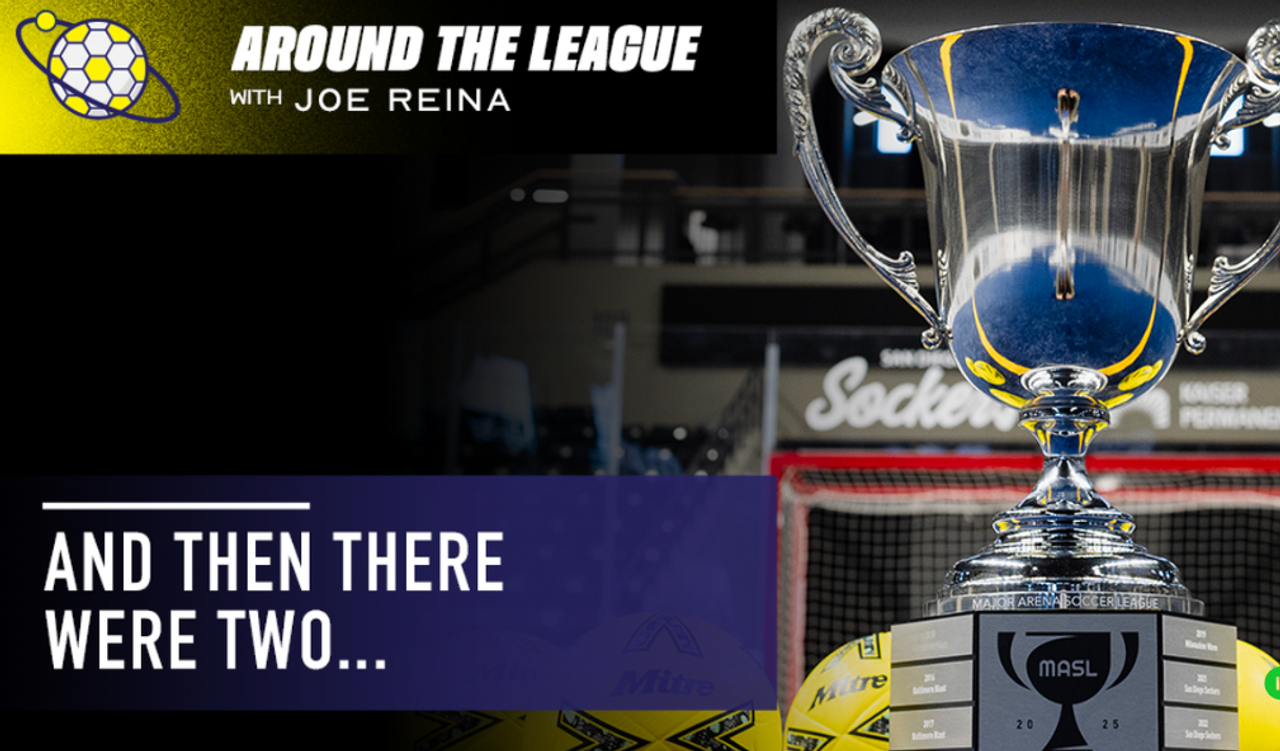
And then, there were two. This is it, the final hurdle that separates the victors and the vanquished. It’s almost time to kick off the Ron Newman Cup Finals between the Milwaukee Wave and San Diego Sockers, but before they do, let’s break down the incredible action on display in the Semifinals and get you ready for the final showdown of the year.
#1 San Diego Sockers vs #4 St. Louis Ambush
San Diego clinched a spot in the Ron Newman Cup Finals with a pair of come-from-behind wins over a gritty St. Louis Ambush side; no knockout necessary. Neither win came easy, but both proved the Sockers are never to be counted out.
This is the Sockers side we expected in preseason. A team loaded with talent, with depth at every position. Their superstars make way for more superstars, and their exorbitant wealth of experience breaks the mold for anything we’ve ever experienced on an indoor soccer field.
In game one, Sockers head coach Phil Salvagio instructed his team to sit back when out of possession, preventing the Ambush from employing their famous and lethal transition game. This allowed the Sockers to save their legs while carefully selecting moments to go sprint for sprint with the Ambush. Jesus Pacheco and Sebastian Mendez played this role to perfection, tiring out St. Louis and forcing them to possess the ball.
In game two, the Ambush came out flying and put the hosts firmly on the back foot. Four first-half goals gave St. Louis a two-goal lead at the break, but their decision to play it conservatively, letting the Sockers control possession from then on, ultimately cost them the game. San Diego put shot after shot on goal, with this year’s Goalkeeper of the Year Paulo Nascimento equal to practically everything until the end of the final frame.
After Tavoy Morgan halved the deficit with seven minutes to go, Ambush midfielder Colin O’Keefe saw blue for his fourth foul in the half, giving the Sockers a power play with time running out. Leonardo De Oliveira equalized with just 10 seconds remaining, setting up a golden-goal overtime where Nick Perera played the role of judge, jury, and executioner.
“The whole year, we were down by two or three goals,” said Salvagio. “More than half our games, and we found a way to win. We’ve had the most overtime wins this year, and hopefully we keep doing it.”
St Louis relies heavily on speed in transition, but what doesn’t get as much credit is the phase of play that makes it all possible. The Ambush boasted the league’s second-fewest goals against during the regular season, and the lowest Defensive Goals Per Shot (0.192).
They do an excellent job of preventing dangerous opportunities, and when their opponents commit numbers forward in the hopes of getting a goal, their transitions create extremely dangerous chances in the opposite direction.
We saw this in moments, most notably Daniel Torrealba’s first goal in game one, when he charged from yellow line to yellow line with the ball before firing a laser past Chris Toth in the Sockers goal. However, throughout the majority of the tie, San Diego’s low block ensured the Ambush had no choice but to turn back and recycle possession after initially surging forward.
This year, more than any, failing to win the Ron Newman Cup should not be considered a failure. For the Ambush in particular, this season should be celebrated. Just two short years ago, this team won just four games. This team finished with a winning season for just the second time in franchise history, joining only the 15-game 2020/21 season. Injuries piled up all season long, but the team seemingly got better the deeper down the depth chart they went, while playing one of the most entertaining brands of indoor soccer we’ve seen in years.
The Ambush rebuilt this roster with an assortment of undervalued talent that fit their system perfectly. Last year’s team put up an incredible fight against the eventual champion Chihuahua Savage; this year, it took two comebacks and two last-minute goals from San Diego to knock them out. They got their “Moneyball” moment with a historic playoff series win over the Kansas City Comets, the first in franchise history, but we must remember that even the 2002 Athletics fell short in the playoffs.
For the Sockers, there isn’t much time to rest and reflect with a trip to Milwaukee looming for game one of the Ron Newman Cup Finals. If they were to do so, they would have every reason to be proud of two statement wins, the likes of which we have not seen from them all season long. Tactically, they were excellent, and individually, they worked magic. We’ll break down their finals outlook below, but first, let’s see how their opponents got here.
#2 Baltimore Blast vs #3 Milwaukee Wave
For the first time since 2019, the Milwaukee Wave will play for a Ron Newman Cup Championship after taking down the visiting Baltimore Blast in a Knockout Game. Efficiency has been the hallmark of Milwaukee’s league-leading offense this season, but that standard was put to the test against the Blast, who boast one of the league’s best defenses.
It wasn’t pretty, far from it, but winning in the playoffs takes adaptation. On seven occasions this season, Milwaukee has finished a game with a GPS under 20%. In those seven games, they won just once, an overtime win over the Ambush all the way back in January. Since then, they haven’t picked up a point in any such circumstance. Against the Blast, however, they won two of three with a total series GPS of 14.8%.
Looking at game one, it seems clear that Baltimore was the better team. They completely controlled the first 40 minutes, leading 6-1 before the Wave scored four to keep Baltimore honest. The 7-5 result seemed to flatter Milwaukee after a performance that felt very “regular-season”.
After game one, the Wave and head coach Marcio Leite needed to go back to the drawing board. They conceded seven goals on the night, many of which came from self-inflicted, unforced errors, alongside a dreadful night offensively. The lone bright spot came from rookie goalkeeper and stand-in sixth attacker Gerardo Perez, whose attacking presence allowed the Wave to control the game more regularly and offered a tangible threat going forward, even assisting Ian Bennett to put his team within one, late in the fourth quarter.
In game two, the Wave gave Perez the start, hoping to control possession throughout the game, rather than when trailing. It’s a tactic we’ve seen from them several times this year, but with their backs against the wall, it’s fair to say benching veteran goalkeeper William Banahene remains a gamble.
The decisive factor in game two proved to be Milwaukee’s defense. The Wave have struggled all year defensively, especially during the playoffs, when attempting to stop their opponents’ star players. In game two, however, the Wave blocked 15 of the Blast’s 26 total shots, a significantly better ratio than any other full game they’ve played all season. Javier Steinwascher accounted for five of those blocks while Oscar Flores, who finished the night with three points, including a SportsCenter Top Play Worthy goal, added a further three.
In the ensuing Knockout Game, Milwaukee fell behind early after a mistake from Perez gifted Baltimore’s Juan Pereira a favorable 1v1 chance he easily converted. The Wave immediately began throwing numbers forward, as Baltimore bunkered in, hoping to hit the Wave in transition and punish their aggressive but necessary 6th attacker play.
Fate would have other plans as Perez, whose mistake put his team behind, leveled the score, shifting the tide firmly back to the host’s side. With the score tied, Milwaukee continued to dominate possession, and with less than a minute to go, they got their reward. Milwaukee forward Andre Hayne fired home from close range to take a 2-1 lead, which they would not relinquish.
For Baltimore, the loss marks the second semifinal defeat in two seasons, underscoring the quality and consistency on display every time the Blast takes the field. It’s worth remembering that this team had just 17 points through its first 13 games and was in the hunt for the last two playoff positions in February. Less than a month later, they were leading the charge for the MASL Shield.
The Blast remains one of the league’s best-coached sides, as evidenced by their impeccable set-piece defending, their overperformance on both sides of the ball, and their incredible consistency. All credit goes to head coach David Bascome and his incredible staff, who ensure this team remains the benchmark for what it means to be a top team in the MASL.
For Milwaukee, the win represents the team’s first trip back to the finals since 2019 and ends the team’s three-year streak of losing in the semifinals. It’s a massive moment for first-year head coach Leite and his staff.
“Our ability to bounce back,” said Leite. “It’s from the confidence we gained throughout the season, knowing that when we are at our best, we can beat anyone. We have a hungry team that wants to win a championship and will do whatever it takes.”
Ron Newman Cup Finals Preview: #1 San Diego Sockers vs #3 Milwaukee Wave
For the first time ever, these two giants of the indoor game will face off with a title on the line. San Diego and Milwaukee have only faced each other 10 times in the MASL era, with the Sockers emerging victorious in seven of those contests. However, two of Milwaukee’s three wins came earlier this season.
Milwaukee’s season began on the road in Oceanside with a dominant 8-4 win over the Sockers. About a month later, the Wave hosted the return fixture and similarly dominated the game, running out 10-5 winners. At face value, it feels like Milwaukee would be the heavy favorites, but given that the Sockers looked very different from the current lineup in those games, both on the roster and in play-style, it’s almost not even worth taking into consideration.
At the time of their most recent meeting, the Sockers were in the midst of a six-game road stretch that coincided with several key injuries. Among the players not available for selection that night were Charlie Gonzalez, Luiz Morales, Ben Ramin, Luis Ortega, and Chris Toth, all of whom played in both games against St. Louis.
At this point, the Sockers are practically at full strength, capable of playing through pressure, defending, and scoring with all three lines. Add in new signings Nilton de Andrade and Stefan Mijatovic, and on paper, you have a roster that simply cannot be touched.
For Milwaukee, the story this year has been evolution. They’ve grown into the season despite winning several key games early on, and they’ve added new looks throughout the season with scoring depth that dwarfs even San Diego.
Seven Wave players finished the regular season with over 20 points compared to just five Sockers players. San Diego’s Nick Perera ended the season as his team’s top scorer with 36 points, a figure matched or beaten by four Wave players, including Oscar Flores, Alex Steinwascher, Mario Alvarez, and Alex Sanchez.
The story of the series will be two elite, high-powered offenses adjusting to slow each other down, and going in, San Diego has the edge. As I mentioned earlier, the Wave has struggled to create dangerous scoring chances during the playoffs, thanks to impressive target defending by Empire and Baltimore. San Diego’s defenders are so good at keeping these target forwards quiet, or at least quieter than usual, and boasted the third-lowest Defensive GPS (20.3%) during the regular season and the highest team save percentage (72.2%) by a healthy margin.
Chris Toth was at his best against St. Louis, finishing both games with a combined 73.9% save percentage, but several of the goals he conceded came from 1v1 scenarios. The Ambush knew to press the Sockers high because their defenders tend to keep the ball on their feet for a second too long. The resulting turnovers become extremely dangerous chances, significantly more likely to lead to a goal.
Milwaukee does this very well, with hand-picked pressing monsters like Alex Steinwascher, Javier Steinwascher, Shawn Azcueta, and Cesar Correa. These players feed off turnover and create dangerous goal-scoring chances with incredible speed. If they can create even more of these situations than St. Louis did, they will be in a good position to win games, but they’ll need to play through the Sockers in possession, too, something they’ve struggled with against similar opponents.
Set pieces and restarts will also need to improve for Milwaukee after a dreadful return against the Blast. San Diego is notoriously deadly in these situations with Perera, Gonzalez, Morgan, Morales, and Leo, and will likely make great use of the Wave’s relative inexperience in these situations.
For the Sockers to win, the tasks are straightforward. Choose carefully when to press because the Wave loves playing through pressure, and ensure the Wave doesn’t get comfortable in possession, especially if Gerardo Perez starts in goal. Offensively, get a lead early and keep the pressure on Milwaukee; don’t drop back and invite pressure. Key to that will be their targets, Perera and Morgan. If those two are allowed to turn and shoot with consistency, there’s very little the Wave can do to counter it.
On the other side, Milwaukee’s keys to victory include outshooting the Sockers, at the bare minimum. Given their recent trajectory, it’s difficult to envision a series in which the Wave are outshot and manage to come out on top. To do that, they’ll need to press high and create a high volume of turnovers, while preventing the Sockers from generating any easy transitions. Expect a tense, tactical battle between two of the best teams we’ve seen this season.
Game 1: Wednesday, Apr. 22; 7:35 pm EDT - UW-Milwaukee Panther Arena
Game 2: Friday, April 24 at 10:30 PM ET - Frontwave Arena
Game 3 (if necessary): Monday, April 27 at 10:00 PM ET - Frontwave Arena