


Around The League // RNC Update
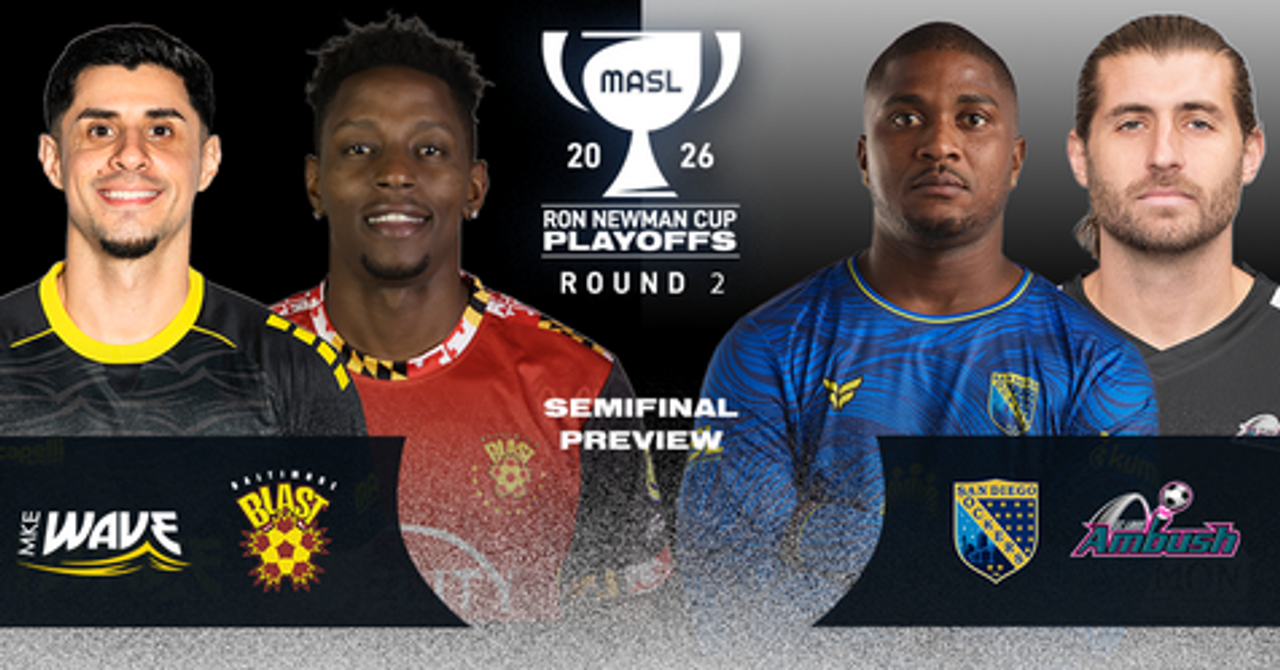
After a grueling and unpredictable regular season, the first round of the MASL Ron Newman Cup Playoffs is in the books, and we have our final four. St. Louis and Milwaukee will advance to play San Diego and Baltimore, respectively, but before we preview these exciting semifinal matchups, let's break down how it happened.
#3 Milwaukee Wave vs #6 Empire Strykers
We’ll start with the first series to conclude. Despite dropping game one on the road, Milwaukee made great use of its home-field advantage with wins in games two and three. Their flat start to the series highlighted the strength of Empire’s defense, but ultimately, the Wave’s ability to adapt and adjust made the difference.
Straight from kickoff in game one, Empire looked ready to make a statement. They jumped out to an early lead, managed the game well, and kept the Wave from finding any rhythm. Milwaukee likes to play through their targets, but when presented with a defense that shut them down in Empire, they didn’t have an answer.
Robert Palmer and the rest of Empire’s defense locked up Milwaukee’s shooters, preventing the likes of Alex Sanchez, Oscar Flores, and Mario Alvarez from finding the scoresheet. Milwaukee resorted to shooting from difficult angles or from distance, and paid the price, with their lowest Goals Per Shot (GPS) of the season (0.103). It narrowly beat out their previous worst return (0.107) from their last trip to the Inland Empire, indicating the Wave’s offense struggles tremendously against the Strykers, especially on the road.
Going into game two, the Wave made a change up top, with veterans Max Ferdinand and Andre Hayne joining the rookie Flores as targets. Additionally, they opted for a deeper line on defense, goading the Strykers to cross midfield before pressing.
Immediately, Empire’s defense struggled with Hayne’s physicality and pressure, while Ferdinand’s play off the ball allowed him to find space and more favorable matchups. Hayne’s opening goal set the tone for the evening, while Ferdinand finished game two with a hat-trick. The Wave staved off a series of Empire comebacks, aided by the incredible transition play of Javier and Alex Steinwasher, and won 7-5, forcing a win-or-go-home game three.
In this 15-minute frame, Empire opted to possess, but struggled to create and convert chances. Milwaukee’s defensive rotations held firm, and on the counter, Ferdinand found the Wave’s breakthrough, very much against the run of play. The Strykers spent much of the remaining 10 minutes with the ball, but only managed to put up six shots. A late full-field goal from Cesar Correa clinched the victory for Milwaukee and sealed Empire’s fate.
“It was a great performance from the team on Monday,” said Wave head coach Marcio Leite. “Our commitment to defending and getting back behind the ball was key to our victory.”
The losses will obscure much of the positive ground the Strykers have covered in recent weeks, but should not erase it. Empire dealt with adversity, made major changes to the team’s style deep into the season, and ultimately improved. For the second successive campaign, they’ve qualified for the playoffs, and they deserve a lot of credit, but the next step is to ensure progress continues.
They’re absolutely one of the league’s most individually talented teams and showed glimpses of their potential when playing with a cohesive structure. Winning in the regular season is one thing, but doing so in the playoffs takes experience, depth, and adaptability.
Milwaukee’s win ensures they will take on the Blast this weekend with a spot in the Ron Newman Cup Finals on the line. The Wave will host both games against the Blast, and for any Wave fans out there to whom that line sounds familiar, it is. The last time these two teams faced off in the playoffs was in 2022/23, when the Blast was forced to play both games in Milwaukee and swept the hosts before facing Chihuahua in the Finals.
This season, the Wave and Blast faced off four times; twice in Baltimore and twice in Milwaukee, with the home teams winning all four contests. It’s important to note that both Wave wins came after overtime. For the Blast, the question isn’t whether they can compete with the Wave, it’s whether they can turn those competitive moments into wins.
“Games against Baltimore are always a battle,” Leite said. “We are expecting a very intense game between two of the biggest franchises in indoor soccer.”
Look for MVP candidate Juan Pereira and star midfielder Jonatas Melo to run the show for Baltimore, with additional support from Oumar Sylla, Chad Poarch, Kevaughn Frater, and the rest of their tremendous ensemble. The transition game will be crucial, as both teams like to win the ball high and turn toward goal. Milwaukee’s Alex Steinwascher will likely feature heavily on both sides of the ball, and don’t be surprised if Friday’s contest turns into a track meet, with Steinwascher leading the charge.
Game 1: Friday, Apr. 10; 7:35 pm EDT - UW-Milwaukee Panther Arena
Game 2: Monday, Apr. 13; 7:35 pm EDT - UW-Milwaukee Panther Arena
#4 St. Louis Ambush vs #5 Kansas City Comets
Rivalries are just better in the playoffs, and the I-70 Series is about as good as it gets. The two Missouri-based teams met six times during the regular season, with the Comets claiming the lion’s share of wins and points, but the Ambush claimed the ultimate bragging rights by eliminating Kansas City for the team’s first playoff series win since 1999.
The series started about as poorly as it could have for the Comets, with an astonishing 9-4 loss at home. Ambush forward Will Eskay owned the turf, scoring or assisting seven straight goals as his team ran rampant behind enemy lines. In the six regular-season games these two teams played, St. Louis converted just over 12.1% of their shots, but in Game One, that figure jumped to 28%.
The Ambush were unstoppable in transition, and their finishing at the end of those runs was superb. Kansas City simply couldn’t contain the speed on display and struggled to keep hold of the reins as the game went on. The Ambush finished the job in the third quarter, outclassing the hosts 5-0. From that point on, the result was a formality.
In Game Two, the Comets showed a bit more promise by embracing the transition game, albeit in phases. Nacho Flores bagged 4 points on the night, including a vintage counterattack goal to take the lead in the third quarter, but even at 5-2, the Ambush always looked within striking distance. The Comets’ defensive mistakes allowed St. Louis to complete a three-goal comeback in the final frame, and though MVP Finalist Rian Marques ultimately scored a decisive 6th goal, the win felt more like an escape.
In the Knockout Game 3, the Ambush utilized some rested legs from Daniel Torrealba and Ozzy Santana to take complete control and speed up play to their advantage. They pressed the Comets in midfield and turned turnovers into dangerous chances, with Colin O’Keefe converting one such chance, giving his side the coveted 1-0 lead. Rather than sitting back and inviting pressure, they kept looking forward, ultimately finding their second goal through Christian Briggs, sealing the win and a spot in the semifinals.
“This is a massive moment for the group and the organization,” said Ambush head coach Jeff Locker. “Kansas City is a great team, and we knew they would bring everything possible. Our guys felt we had been growing and learning all season and were ready for the challenge.”
It’s hard to say with any degree of certainty what went wrong for the Comets, but they just couldn’t get the looks they needed to in any of the three games. In the playoffs, it’s so important to have depth, and specifically scoring, from more than just your top attackers. Teams are doing everything they can to stop their opponent’s difference-makers, like Rian Marques and Zach Reget. When they’re getting double-teamed and forced outside, who is ready and willing to become the focal point?
For the Comets, Flores stepped up in Game Two, and Dom Francis added three goals in the series, but there really wasn’t much help beyond them. In these big games, they need to be able to give their 4th or 5th scorers the ball and make something happen. The Ambush did a great job of limiting those superstars for the entire series, and the Comets suffered massively.
As St. Louis begins preparations for its series against the Sockers, the team has only one game to reflect on personally. The Ambush visited San Diego in late March, one day after beating the Stars in Tacoma, and fell to the Sockers 5-4 in overtime after leading 4-1.
Travel and fatigue no doubt played a part in the result, but looking at how the game went, it was apparent that San Diego struggled to keep up with St. Louis's pace. When the game slowed down, the Sockers thrived, so going forward, the Ambush will look to keep the game fast, with disciplined, deliberate pressure in dangerous areas of the field.
As a bonus, San Diego hasn’t played at the Family Arena this season, so we’re getting a completely fresh look between two teams that, on paper, could not be more different. A key factor will likely be Sockers goalkeeper Chris Toth. Since returning from injury in late February, he’s saved over 77% of shots that he’s faced, significantly higher than the league average. If he stays hot, it’s hard to see a world where San Diego doesn’t progress and win its third Ron Newman Cup.
Game 1: Friday, Apr 17; 8:05 pm EDT - The Family Arena
Game 2: Sunday, Apr. 19; 8:00 pm EDT - Frontwave Arena